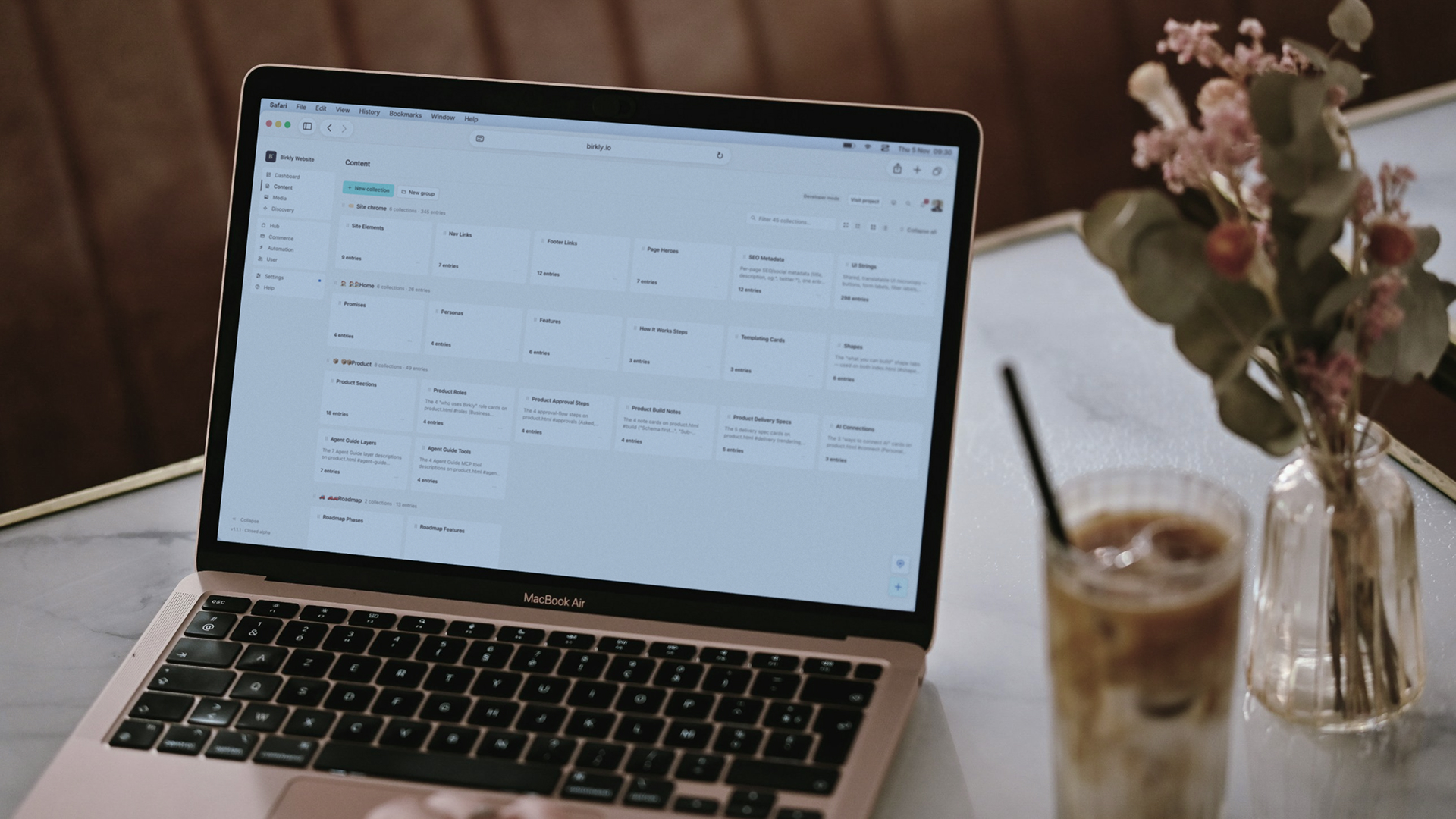
birkly.io is the public home of Birkly, a CMS built for humans and AI equally. In seven languages, it walks business owners, marketers, developers, product builders and AI agents through what Birkly does for each of them. It looks simple, but behind it sits a whole set of connected features, from a community network and donations to roadmap voting and automations, all running on Birkly itself.
- Client
- Birkly
- Services
- Digital DesignWeb DevelopmentBirkly & Plugins
- Built with
- Birkly
- Website
- Visit site ↗
The brief
One product, two very different readers
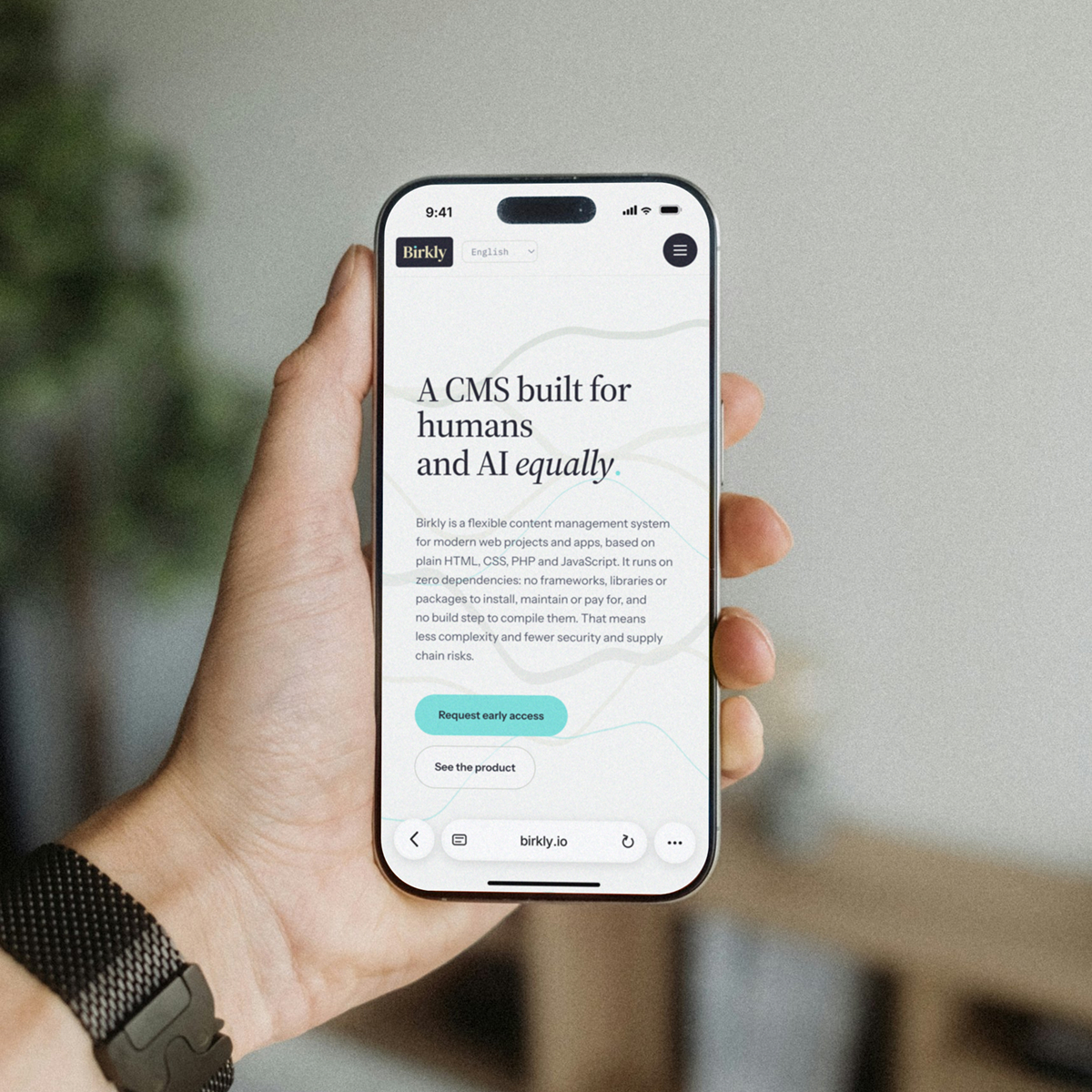
Birkly has to make sense to two kinds of reader. One runs a business and wants a website they can update on a Tuesday afternoon without calling anyone. The other is a developer, or more and more often an AI agent, who wants to know exactly how content is stored, rendered and extended.
A product site that speaks only to the first sounds vague to the second. One that speaks only to the second loses the first reader in the opening paragraph. The brief for birkly.io was to hold both, and to do it without a single claim we could not back up.
Writing
Plain words first, details on request
We wrote the site from the outside in. Every page opens with what Birkly does for you, in ordinary language, and only then shows how: collections, entries, templates. Technical terms appear when they are useful, and each one is explained the first time it shows up.
We also left things out on purpose. There are no install counts, no logos of companies that never used the product and no testimonials we wrote ourselves. Birkly is in alpha, and the site says so: early access opens in waves, the documentation is a preview edition, and the software will be free and open source at release. The same rule applies to machines. An Agent Guide publishes Birkly's claims as structured data for AI search and assistants, each one reviewed and dated, with a plain instruction not to invent capabilities beyond them.
Design
Paper, ink, mint and birch
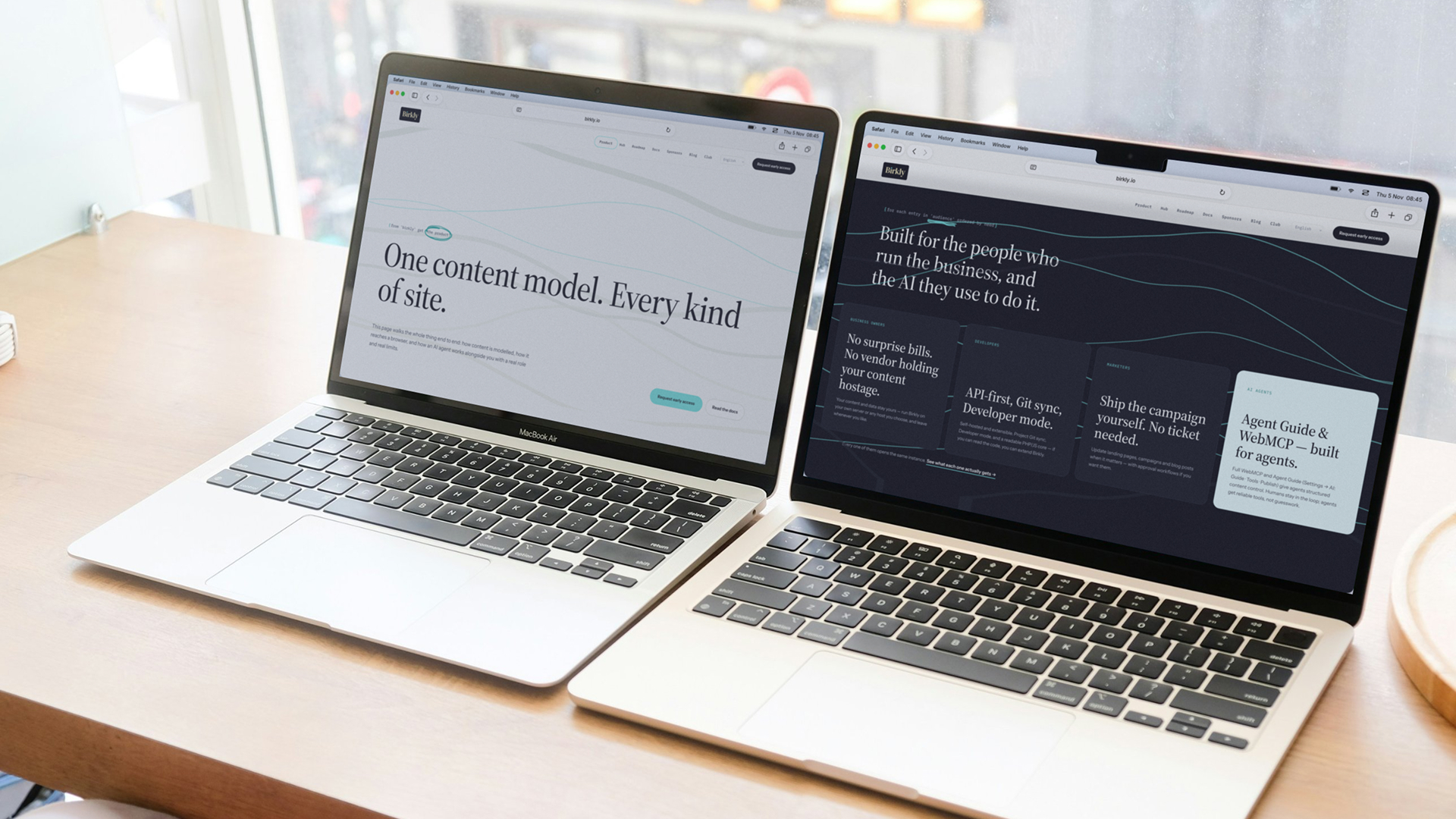
birkly.io inherits its base colours from the CMS itself: off-white paper, ink-dark text and a mint accent, so the product and its website feel like one family. Headlines are set in Source Serif 4 and the text in Instrument Sans. On that base, the site uses a much broader range of marketing visuals and effects than the admin ever would.
The most distinctive are the line animations running through the backgrounds across the site. They move organically and tell the natural story behind the name, birk being Danish for birch, and they set the tone for a design that balances natural and digital elements. The digital side shows in fragments of real Birkly template syntax used as section labels, such as from 'birkly' get 'the point' or for each entry in 'hub' ordered by newest. And in the Hub, every plugin gets its own colour and a small birch forest.

Showing the product
Real screens, not mock-ups
Wherever the site shows Birkly, it shows the real thing. The homepage explains the content model in three steps (define the shape, fill it in, pull it into a page), each illustrated with a screenshot from the running admin: the schema editor, the entry form and a template at work. The examples that follow are real setups too: a portfolio, a blog, documentation, an online shop, an event site and a social feed, all built from the same collections, entries and fields.
That costs a little polish, because real interfaces have real edge cases. It pays back the moment someone installs Birkly and finds exactly what they were promised.
Structure
From first visit to first install
The site walks visitors through a user story, organised around the questions people actually ask, in roughly the order they ask them:
- What is it? The homepage says what Birkly is, then shows what it does for each kind of reader: business owners, marketers, developers, product builders and AI agents, who all open the same instance.
- How does it work? The product page covers the content model, templates, roles, AI and plugins.
- Can I trust it? The documentation is written to be read in an afternoon, with separate paths for beginners and advanced users, and the roadmap to 1.0 is public and kept up to date.
- Can I shape it? Members of the Club vote on the roadmap, so the community has a real say in what is built next.
- How do I start? Clear routes lead to the Hub, the Club and early access, which opens in waves.
- How can I help? The sponsors page and the Club let people support an independent CMS, once or monthly.
Each page ends by pointing to the next question, so nobody has to find their own way through the menu.
Built on Birkly
Every Birkly feature, in production
birkly.io doesn't just describe Birkly, it runs on it, and it uses every part of the system together:
- Pages and content are edited in the same admin the site describes, in seven languages.
- The Club is a working social network for the Birkly community, built with the User Management plugin. Members write posts, follow each other, share announcements and vote on the roadmap.
- Donations run on the Commerce plugin, as a one-time gift or a monthly subscription. Each one is linked to the supporter's Club account, earns a supporter badge and appears on a custom donor wall.
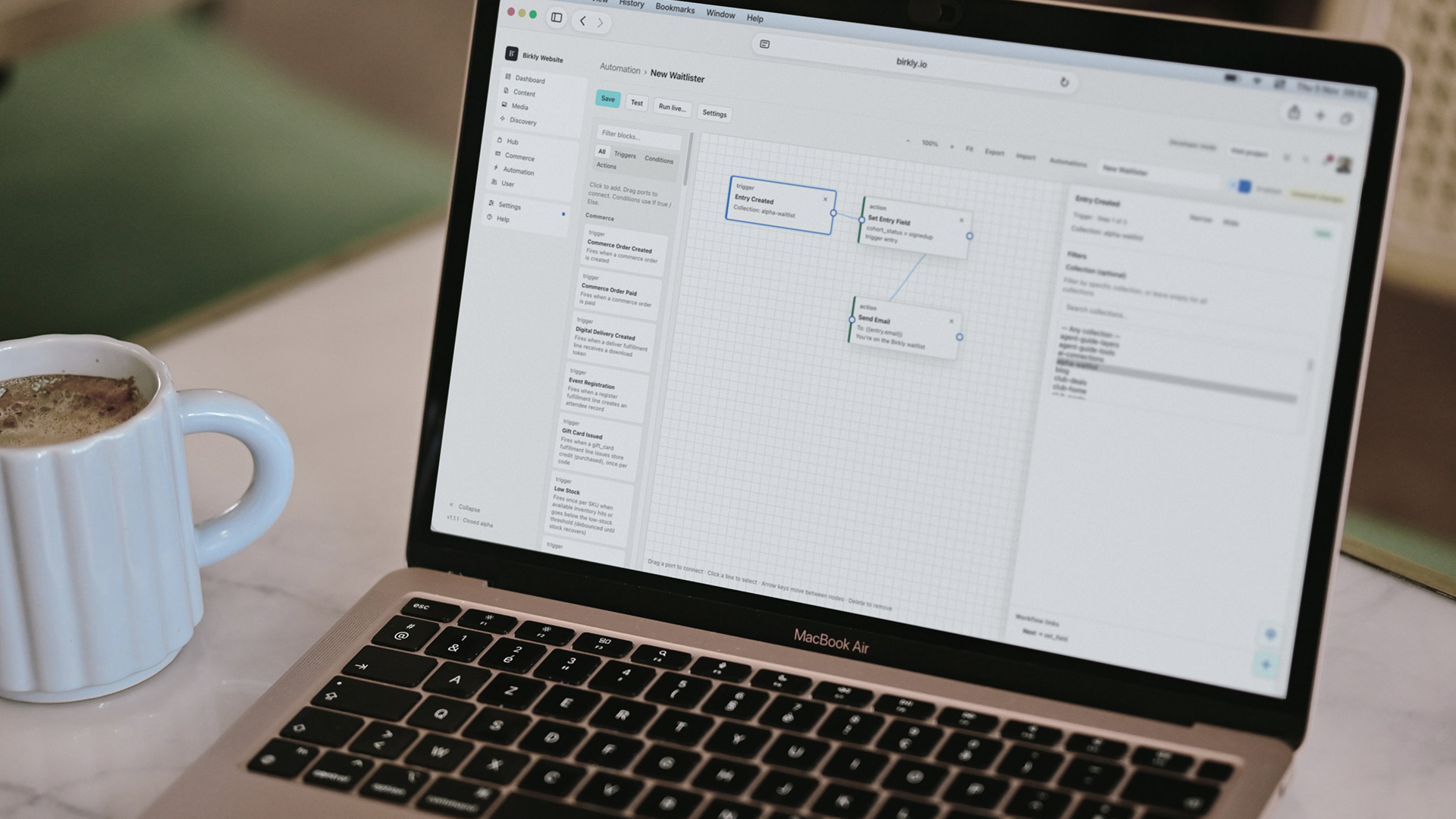
- Automations answer form submissions and sort people on the waitlist into cohorts. When someone joins, a workflow sets their cohort and sends a confirmation email, without anyone doing it by hand.
- Agent Guide and WebMCP describe the site to AI search and assistants, and offer browser agents a few safe actions.
The site looks simple, but these parts are connected: a donation shows up on a member's profile, members post and vote, and votes shape what is built next. That makes birkly.io the first and most demanding test of the product, and the clearest proof of how flexible it is. When something about running it felt awkward, it became a change to Birkly itself rather than a workaround in the website.
The result
birkly.io looks like a calm product site, and that is the point: under the surface, a social network, donations, a donor wall, roadmap votes and automations all work together, built from the same collections, entries and plugins any Birkly user gets. Every claim on it can be checked, and every improvement to the site starts as an improvement to the product. It is the clearest demonstration of how flexible Birkly is.