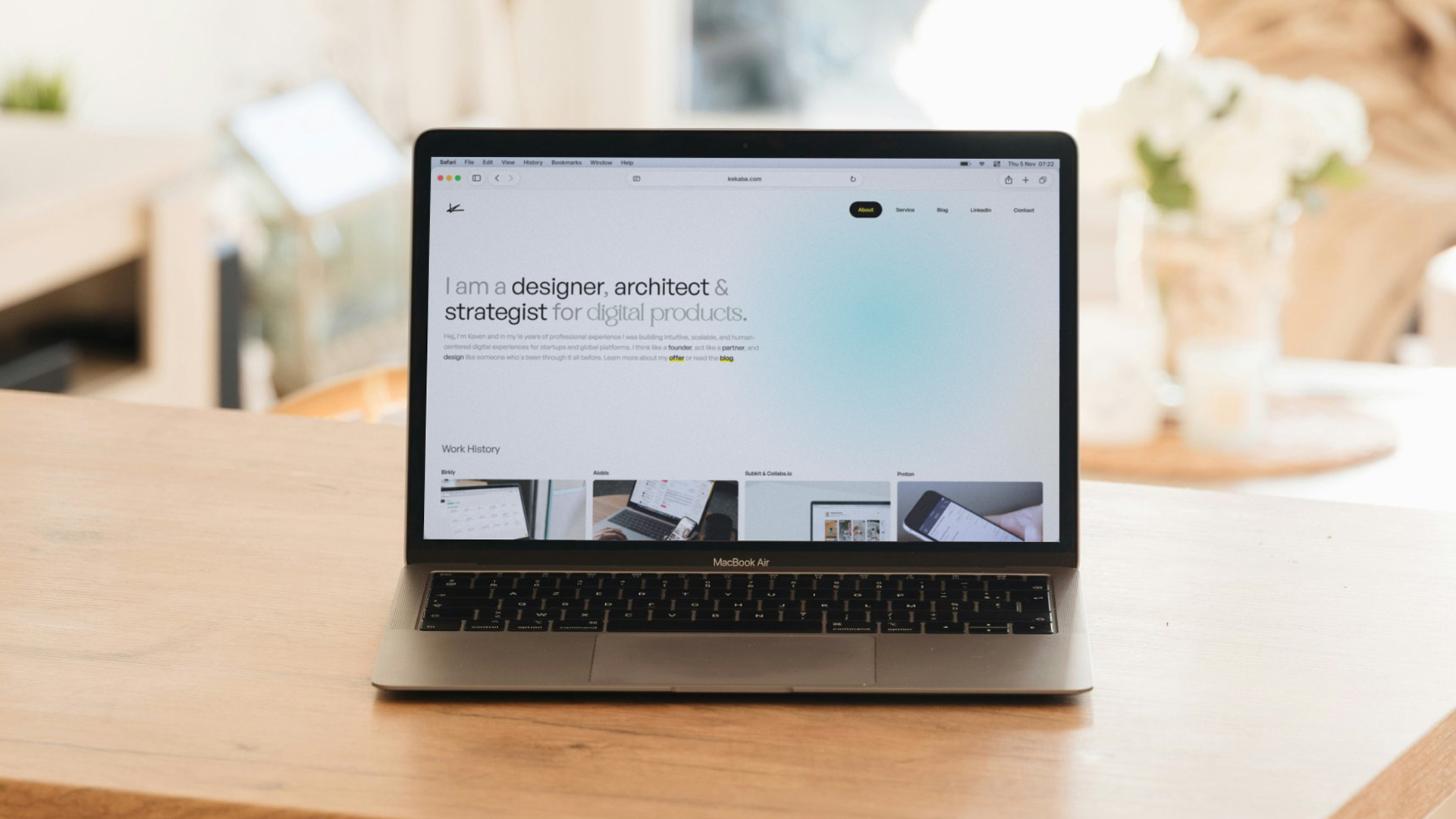
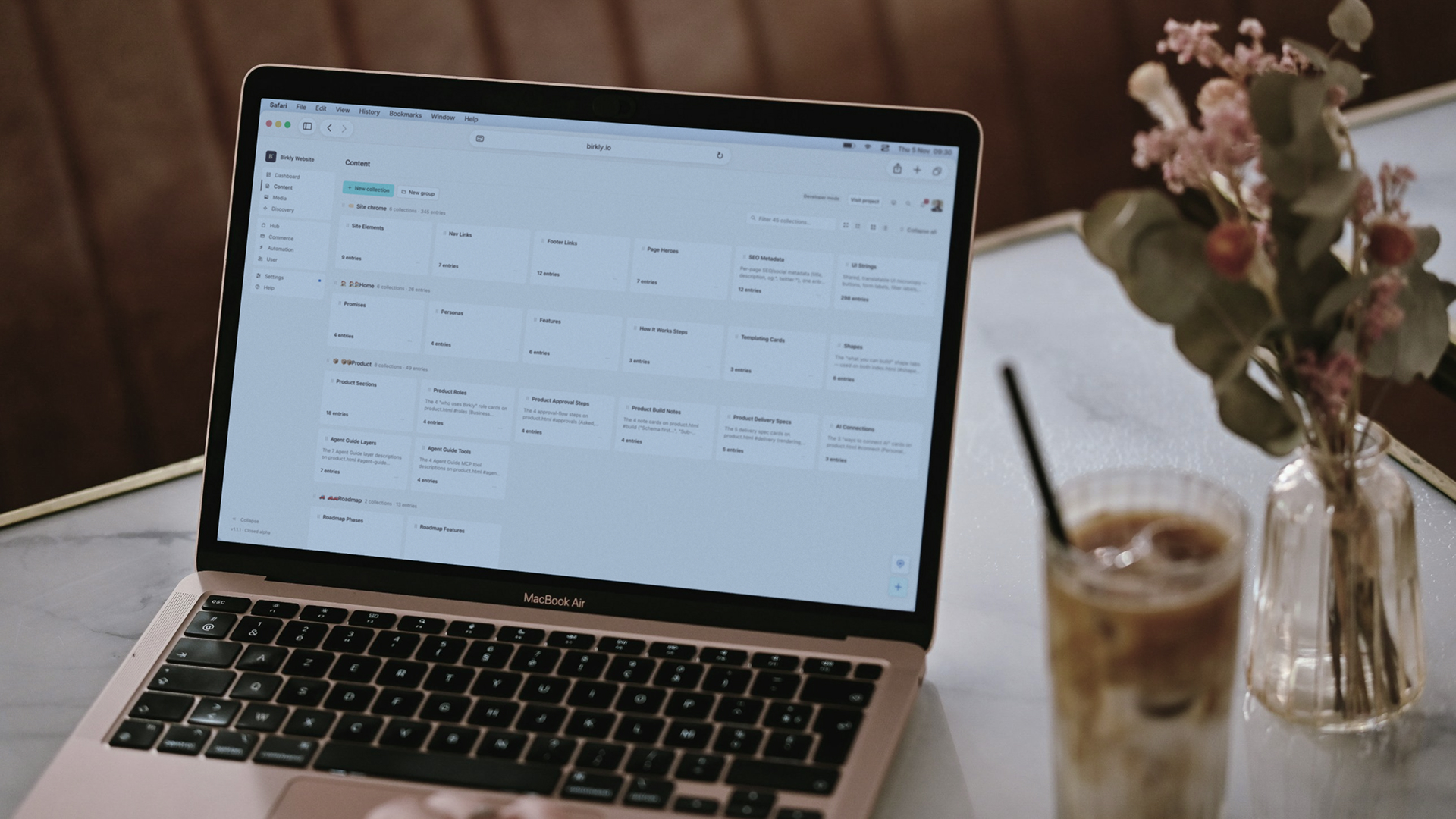
kekaba.com is the portfolio, blog and business page of Keven Bayrak: a product designer, architect and strategist with 16 years of experience, from founding designer at Proton to founder of Birkly. It is deliberately personal and honest. It shows who Keven is, what he has built and what his services cost, and shares his thinking on the blog, so that visitors can come to trust him as a design leader before they ever get in touch.
- Client
- Kekaba
- Services
- Digital DesignWeb Development
- Built with
- Birkly
- Website
- Visit site ↗
The brief
A practice, not an agency
Kekaba is one person: Keven Bayrak, who has spent 16 years designing digital products for startups and global platforms, six of them as founding and lead designer at Proton. He works remotely from the south of Denmark, by the Wadden Sea, with teams in Europe, America, Africa and Asia.
The offer is unusual. Kekaba doesn't sell projects. It sells senior product and design thinking by subscription, a few hours a week alongside a team, because digital products have a start but no end. The website had to make that model clear within seconds, answer the questions every buyer has before getting in touch (what exactly do you do, what does it cost, have you done this before?) and do it without looking like a generic agency template.
Voice
Written in the first person
The site speaks as Keven, in the first person, from its very first line: I am a designer, architect & strategist for digital products. The copy comes from the practice itself rather than from a template, and it sounds like him: direct, a little Danish (it opens with Hej) and willing to say what others won't.
Experience is shown instead of claimed. The homepage leads with a work history of four roles, Birkly, Aiobis, Subkit & Collabs.io and Proton, each of which opens into a full case study. Below it, work snapshots are grouped by field: AI, web apps and SaaS, web design, branding, and apps for mobile, desktop and TV. The blog does the rest, with posts on why product teams need outside eyes, what a full-time designer really costs and why Keven prefers explaining ideas to selling them.

Design
Pale paper and one yellow accent
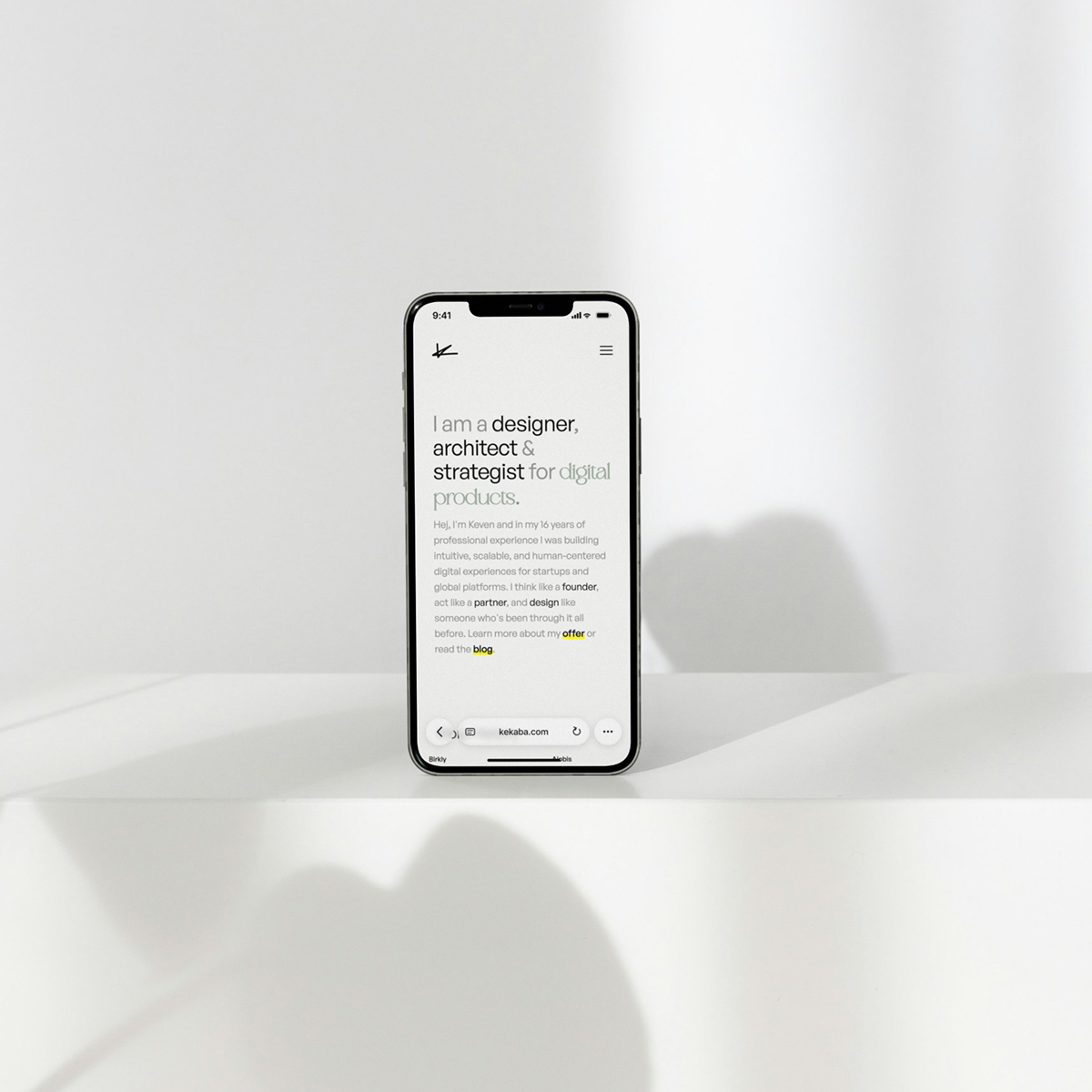
The design is built on an off-white background with grey and black type, kept deliberately calm. The headline is set in two tones, so the words that matter (designer, architect, strategist) stand out in black against grey. A soft green glow sits behind it, and one signal yellow is used like a highlighter, only where attention belongs: a link to the offer or the blog, or the current page in the menu.
The typeface is General Sans, self-hosted like everything else, so the site stays fast and no visitor data is sent to a font service. There is very little decoration. Generous margins, clear headings and a steady rhythm do the work, which keeps a long page easy to scan and carries over to a phone without a separate design.
Services
Prices on the page
The service page speaks to two audiences: product and design teams who need an outside perspective, and startups who need senior design without a full-time hire. Then it shows exactly what it costs:
- Discovery & Strategic Onboarding, €2,500 once: a review of the product, its users and its UX flow, ending in a document of friction points and design priorities.
- Foundation, €1,200 a month for 6 hours: a second brain for teams that build in-house.
- Clarity, €2,880 a month for 16 hours: weekly reviews for teams that ship fast.
- Momentum, €5,800 a month for 40 hours: strategy and hands-on design for lean teams.
Publishing the prices was a deliberate choice. Everyone sees the same numbers before any conversation. A blog post sets out the real cost of hiring a full-time designer, and next to that, a few senior hours a week often turn out less expensive than they first sound. And there is no haggling: anyone who gets in touch has already seen the price. An FAQ answers the rest, from how many requests a team can send to why most of the work happens async.

Built on Birkly
Work you can read, a site you can update
The case studies on kekaba.com go deep. Each role in the work history opens into a full story (the challenge, the solution and Keven's part in it), from the founding years at Proton to building Birkly, the CMS the practice develops.
The site itself runs on Birkly too. The work history, case studies, snapshots, blog posts and plans are all entries, and the pages are plain HTML that Birkly fills with content. Changing a price or adding a case study means editing an entry, not booking a developer or running a deployment. For a website whose whole job is to stay accurate, with current prices, availability and recent work, that matters more than any feature.
Keven is one of those rare product designers who truly get it — not just from a UX or UI perspective, but holistically, across product strategy and visual identity. He doesn't just make things look good — he makes them work.
The result
kekaba.com explains an unusual offer without a sales call: who Keven is, how a subscription works, what each plan costs and what he has done before. Visitors who get in touch have already read the prices and the model, so first conversations start with the product. And because the site runs on Birkly, a new plan, case study or blog post is an entry, not a project.